

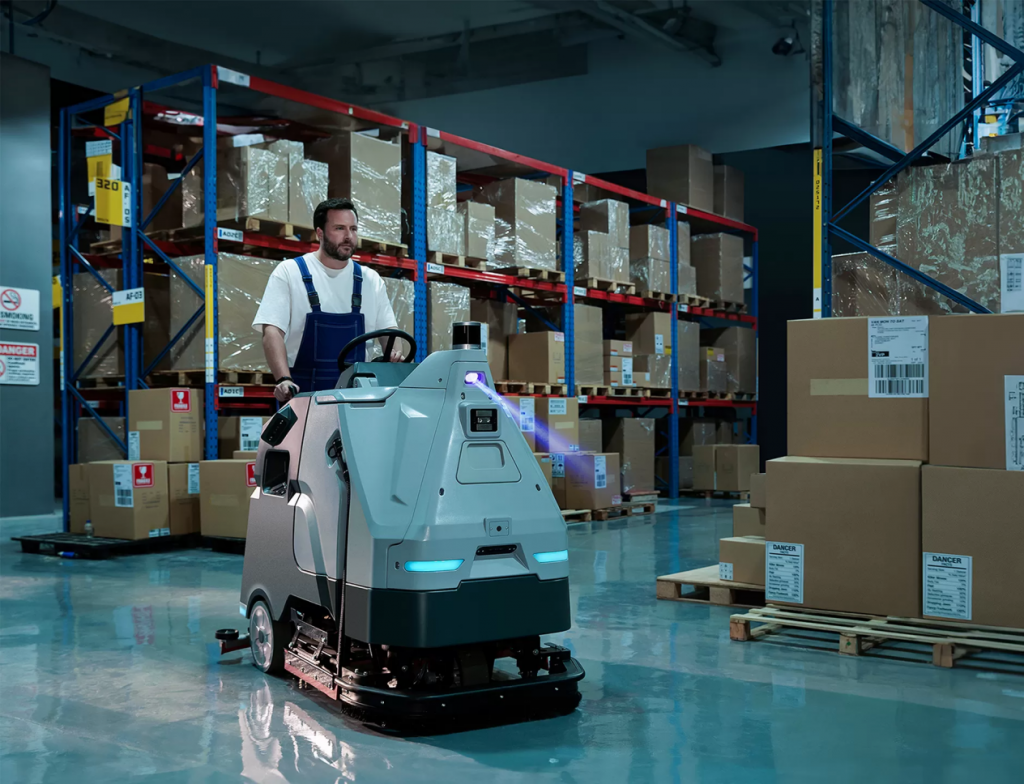
Warehouses and logistics centers run forklifts and constant foot traffic across the same open floor space, often in round-the-clock shifts. That mix turns floor cleaning into a safety question, not just an appearance one, since spills and debris sit in aisles where equipment and workers cross paths.
Companies like Rosiwit build commercial robots specifically for these heavy-duty, obstacle-dense environments. This guide covers why large industrial facilities struggle with manual cleaning, and what to look for in equipment built to keep pace with a warehouse floor.
Why Do Warehouses and Logistics Centers Struggle to Keep Floors Clean Around Forklifts?
Large industrial floors create two problems at once: too much square footage for manual crews to cover, and too much moving equipment for cleaning staff to safely work around.
What Makes Forklift Traffic a Cleaning and Safety Challenge?
Forklifts and pedestrians sharing the same floor space is inherently risky, and cleaning staff add another body to that mix. The Occupational Safety and Health Administration (OSHA) estimates forklift-related incidents cause roughly 85 fatalities and 34,900 serious injuries in U.S. workplaces every year, with pedestrian strikes among the leading causes. A cleaning crew working the same aisles a forklift uses adds exposure to that risk with every pass.
Why Does Manual Cleaning Fall Behind in Large Industrial Facilities?
Manual crews struggle once a facility runs multiple shifts without a natural break in floor traffic. Because forklifts, pallet jacks, and personnel keep moving throughout the day, there is rarely a clear window to close an aisle for cleaning without disrupting operations.
| Facility Type | Common Cleaning Challenge |
| Warehouse | Wide-open floor plans, high forklift traffic |
| Logistics Center | Multi-shift operation, no natural cleaning window |
| Factory Floor | Fixed equipment obstacles plus forklift traffic |
What Should You Look for in an Industrial Robotic Floor Scrubber?
An industrial robotic floor scrubber should be judged first on how reliably it detects and reacts to moving equipment, then on how much floor it covers per shift.
How Does Navigation Around Forklifts and Pallets Actually Work?
Reliable navigation combines LiDAR (Light Detection and Ranging) mapping with real-time obstacle detection, so the robot can tell a stationary pallet rack from a forklift about to cross its path. This matters more in a warehouse than a retail store, since forklifts move faster and less predictably than shoppers.
Which Cleaning Performance Specs Matter for Industrial Floors?
Down pressure and cleaning-path efficiency matter more on industrial floors than on retail-grade concrete, because warehouse floors accumulate heavier debris and ground-in grime.
- Down pressure (kg): force applied to lift embedded dirt and grease
- Cleaning efficiency (m²/h): floor area covered per hour of operation
- Tank capacity (L): how long the machine runs before a refill
How Does Rosiwit’s Titan 810 Handle Heavy-Duty Industrial Sites?
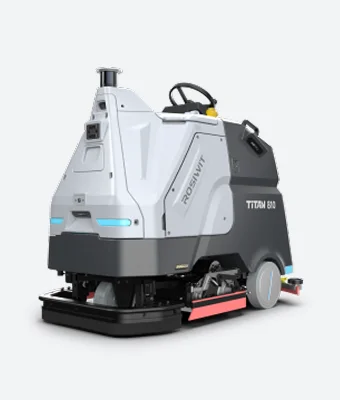
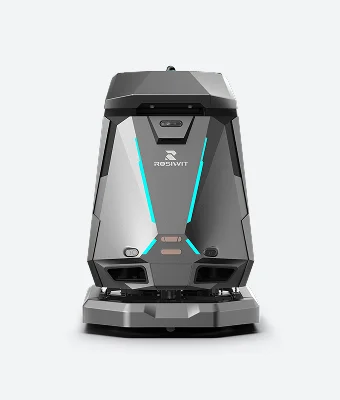
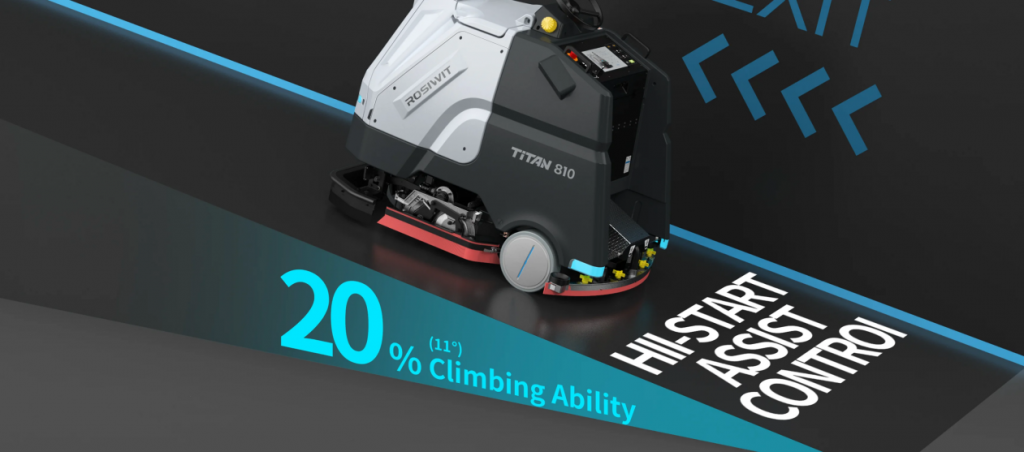
Rosiwit’s Titan 810 is an industrial cleaning robot built for warehouses, logistics centers, and factory floors where forklifts and pallets share the same aisles. It combines 3D LiDAR mapping with an NVIDIA 100 TOPS computing platform to plan routes and react to moving equipment.
What Are the Titan 810’s Core Specifications?
| Titan 810 Feature | Specification |
| Cleaning efficiency | 5,200 m²/h |
| Down pressure | 115 kg |
| Working width | 810 mm |
| Runtime | 6.5 hours |
| Tank capacity | 150L solution / 190L recovery (340L total) |
| Weight | 450 kg |
| Gradeability | 11° |
| Compatible floors | Concrete, epoxy, tile, terrazzo, marble |
How Does the Titan 810 Stay Productive Across Long Shifts?
The 5-in-1 smart workstation and cloud platform keep the robot running without pulling staff into routine maintenance. Rosiwit 365 gives facility teams mobile visibility into task progress and equipment history, while the workstation handles servicing between shifts.
What Happened When Titan 810 Was Deployed in a Large-Scale Facility?
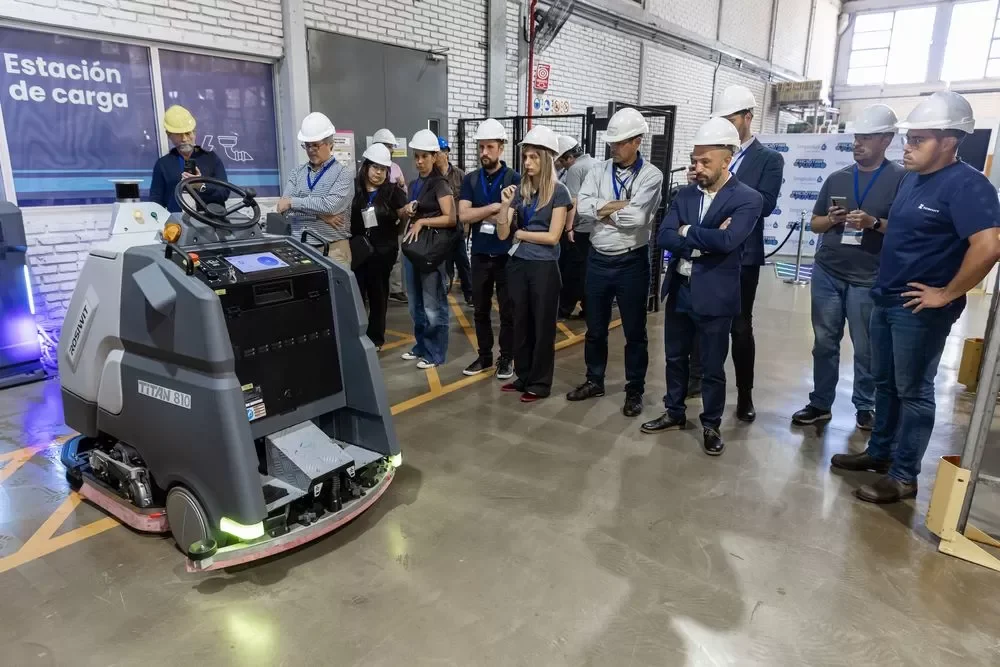
A facility management company in Argentina, with nearly 60 years in the South American market, deployed Titan 810 alongside Skywalker 50 in a dual-robot strategy across its large-scale sites.
How Did an Argentina Facility Management Company Apply This?
- Context:The company had relied on semi-autonomous equipment that still needed constant supervision, while regional demand for automated cleaning kept growing.
- Action:It deployed Titan 810 for large-scale industrial areas alongside Skywalker 50 for mid-sized spaces, both connected to Rosiwit’s cloud platform for remote monitoring.
- Result:The deployment cut energy consumption by 85%-90% and reduced water use by more than 60% compared to traditional cleaning methods.
- Feedback:The company’s executive management said they had “sought truly autonomous cleaning solutions” after finding most available equipment still semi-autonomous, and selected Rosiwit as a result.
What Should You Check Before Buying a Heavy Duty Floor Scrubber?
A heavy duty floor scrubber is a capital purchase for most facilities, so deployment time and after-sales support deserve the same scrutiny as the spec sheet.
How Long Does Deployment Take for a Large Facility?
Deployment for an industrial site takes longer than a single-room installation, since the robot needs to map the full facility before running unsupervised. Ask any supplier for the actual timeline from delivery to a tested route, not just the day the unit arrives.
Why Does Overseas After-Sales Support Matter for Industrial Equipment?
A stalled industrial robot costs more than a stalled walk-behind scrubber, since it covers a larger share of the facility’s floor space. Confirm parts-stock location and response-time commitments for imported equipment before signing a purchase order, since a multi-shift facility cannot wait days for a replacement part.
- Facility managers:confirm the mapping and setup timeline before installation day, and verify parts-stock location for your region
- Distributors:ask about training materials for onboarding client staff, and confirm response-time commitments you can pass on to clients
Conclusion
For warehouses, logistics centers, and factory floors built around forklift traffic, the right industrial cleaning robot is the one that navigates safely around moving equipment while covering enough floor space to matter.
- Confirm how the robot detects and reacts to forklifts and pallets, not just people
- Check cleaning performance specs against your actual floor size and debris level
- Verify deployment timeline and after-sales response before signing a purchase order
Titan 810 is designed to meet each of these checks, and its full specifications are available on Rosiwit‘s product page for facility managers and distributors evaluating the fit.