

A robot suits large public spaces when it does three things well: it navigates dense foot traffic safely, covers big floor areas in one charge, and keeps running around the clock with little human help. Venues like airports, malls, and hospitals cannot pause for cleaning, so these three traits decide whether automation actually fits. The sections below break each one down.
Why Do Large Public Spaces Need a Different Kind of Cleaning Robot?
Large public spaces need a different robot because their scale and crowds break what smaller machines are built for. A commercial cleaning robot made for a small office cannot handle an airport concourse that never empties.
The core issue is constant human presence. Terminals, malls, and hospitals see foot traffic at nearly every hour, so the robot must clean around people rather than wait for an empty room.
Scale is the second issue. A single venue can span tens of thousands of square meters across several floors, so a suitable robot is defined by endurance, coverage, and awareness, not just cleaning power.
What Core Capabilities Define a Suitable Robot for Big, Busy Venues?
Three capabilities are central: navigation in dynamic environments, efficient coverage of large areas, and operational support for multiple cleaning shifts. Together they separate a robot that copes with a busy venue from one that stalls in it.
How does it navigate crowds without stopping the flow?
It navigates crowds using SLAM mapping and multi-sensor perception that track people and obstacles in real time. SLAM (Simultaneous Localization and Mapping) builds a live map, while LiDAR, vision, and ultrasonic sensors detect movement around it.
Because these sensors work together, the robot reroutes around a passing cart or a standing group instead of freezing. A commercial floor cleaning robot in a mall aisle slows, steers, and continues, so foot traffic keeps flowing.
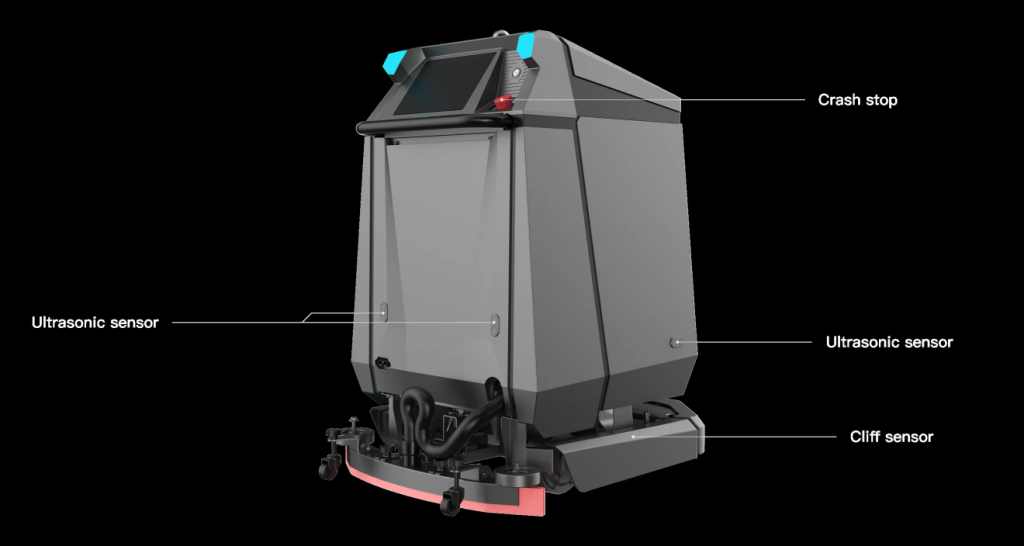
The Skywalker 50’s sensor suite: 3D LiDAR, binocular camera, ultrasonic, and anti-collision.
How does it cover huge floor areas efficiently?
It covers large areas through wide cleaning paths, long runtime, and fast recharging. A wider brush cleans more floor per pass, and planned routes prevent missed or repeated zones.
Edge handling matters too. An edge-cleaning mode allows the robot to operate approximately 10 cm from walls, shelves, and corners, which can reduce the amount of manual edge cleaning required. One machine can then hold a large floor to a consistent standard, shift after shift.
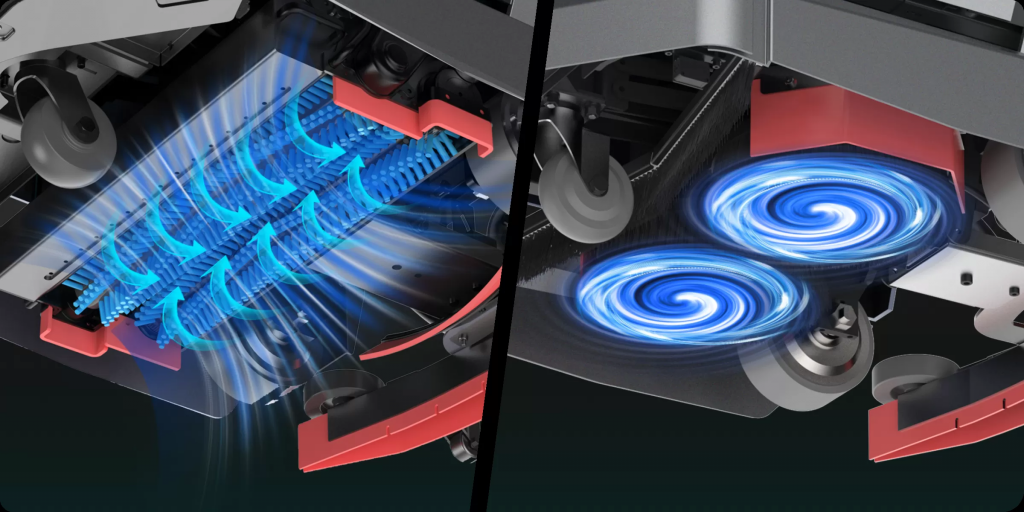
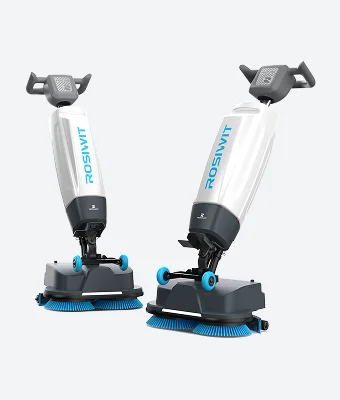
Deep-scrubbing roller and disc brushes tackle stubborn stains across large floors.
How Do You Keep a Robot Running 24/7 Across Shifts?
You keep a robot running around the clock by automating whatever would otherwise need a person. When it recharges, refills, and drains on its own, uptime no longer depends on staff being present.
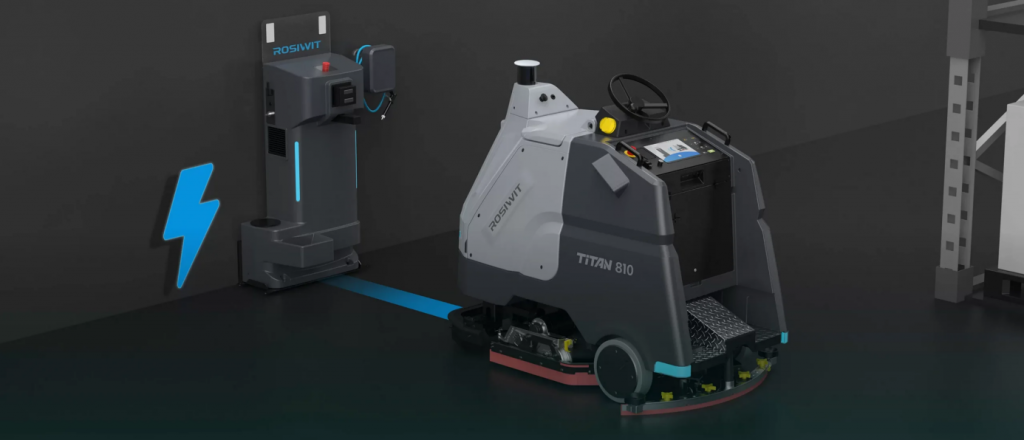
A docking station handles this cycle: it recharges the battery, refills clean water, and empties wastewater, so cleaning resumes without a manual reset. Fast charging shortens the gap between runs.
Cloud management ties it together. A platform for scheduling, remote monitoring, and diagnostics lets one supervisor oversee a whole fleet of cleaning robots commercial operators run across floors. Coverage then extends across every shift, including overnight, without adding headcount.
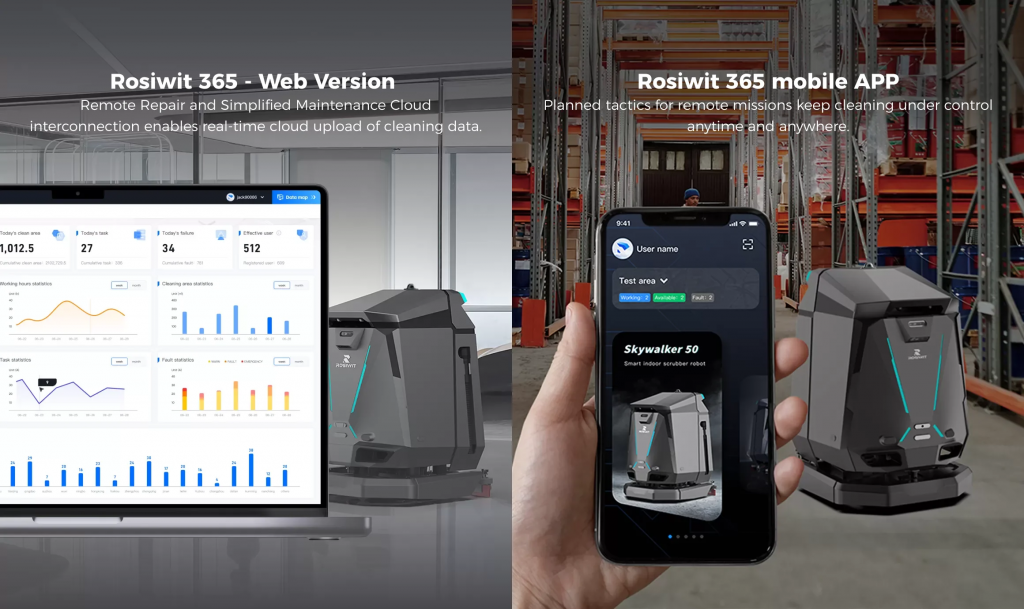
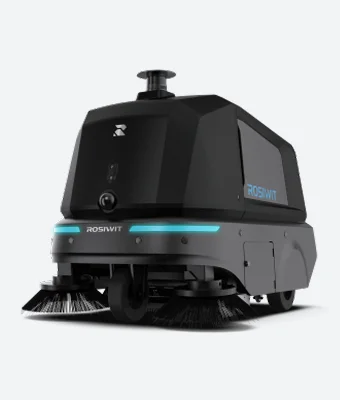
Built for transport hubs, parking structures, and industrial facilities.
| Task | Manual crew | Automated robot workflow |
| Recharging | Operator plugs in and waits | Auto-docks and fast-charges |
| Water / waste | Manual refill and dumping | Station refills and drains |
| Scheduling | Depends on shift coverage | Cloud-scheduled, runs overnight |
| Oversight | On-site supervision per machine | Remote monitoring of a fleet |
Which Rosiwit Robot Fits Large Public Spaces?
At Rosiwit, we offer the Skywalker 50 for indoor commercial, transportation, healthcare, industrial, and logistics facilities.
The Skywalker 50 is an indoor commercial cleaning robot that scrubs and mops hard floors. It uses SLAM navigation with panoramic 3D perception from LiDAR, binocular vision, ultrasonic, and bumper sensors, so it maps and moves without QR-code markers.
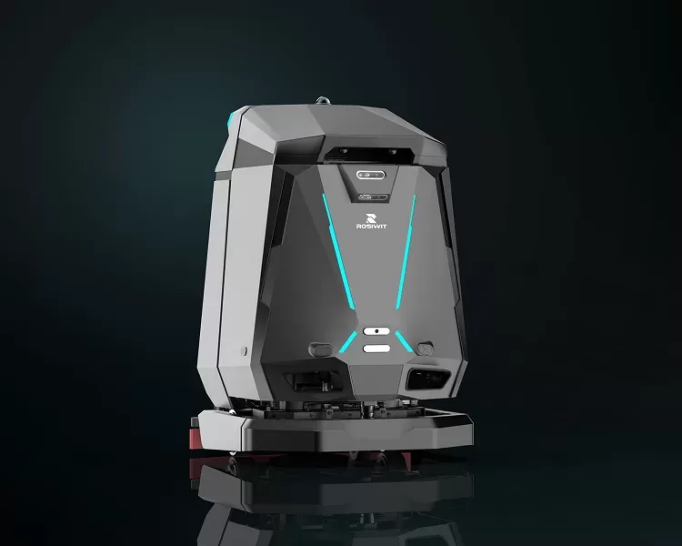
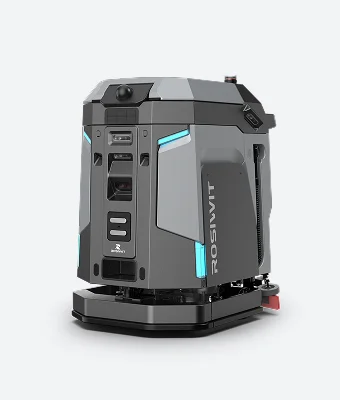
Rosiwit Skywalker 50 indoor scrubber robot.
For coverage, it has a 500 mm working width, a cleaning efficiency of up to 1,800 m²/h, up to 29 kg of down pressure, and 40 L/36 L solution and recovery tanks. Its edge-cleaning mode reaches within about 10 cm of walls.
For uptime, an optional workstation automates recharging, water refill, and drainage, with fast charging in about one hour versus three. The Rosiwit 365 cloud platform adds remote scheduling, monitoring, and diagnostics, and the robot can operate elevators where supported.
| Spec | Skywalker 50 |
| Best-fit environment | Large indoor public spaces (malls, airports, hospitals) |
| Cleaning width | 500 mm |
| Cleaning efficiency | Up to 1,800 m² / hour |
| Down pressure | 29 kg |
| Water tanks | Dual 40 / 36 L |
| Navigation | SLAM + 3D perception (LiDAR, vision, ultrasonic, bumper) |
| Charging | Fast charge ~1 hour (standard ~3 hours) |
For facilities planning a new deployment, the Skywalker GT is the next-generation model following the Skywalker 50. It continues Rosiwit’s focus on autonomous indoor floor cleaning while introducing upgrades for more demanding, long-duration operations. Its AI-integrated perception system combines 3D LiDAR, RGB-D vision, and ultrasonic sensing to identify suspended, low-lying, and moving obstacles in busy environments. The robot also features six-layer safety protection, up to 33 kg of down pressure, extended operating time, and scrubbing noise as low as 60 dB. These improvements make it suitable for malls, hospitals, transport facilities, warehouses, and other large sites where cleaning must continue around daily operations.
How Does a Cleaning Robot Perform in a Real Public Space?
In practice, a suitable robot holds a busy venue to a steady standard while people keep moving through it. Our deployment of 17 Skywalker 50 units across the 17 stations of Xi’an Metro Line 10 provides an example of their use in a live transit environment.
A metro network is one of the hardest public spaces to clean, because passenger flow is continuous, concourses are long, and there is almost no closing window. Manual crews struggle to keep pace without getting in commuters’ way.
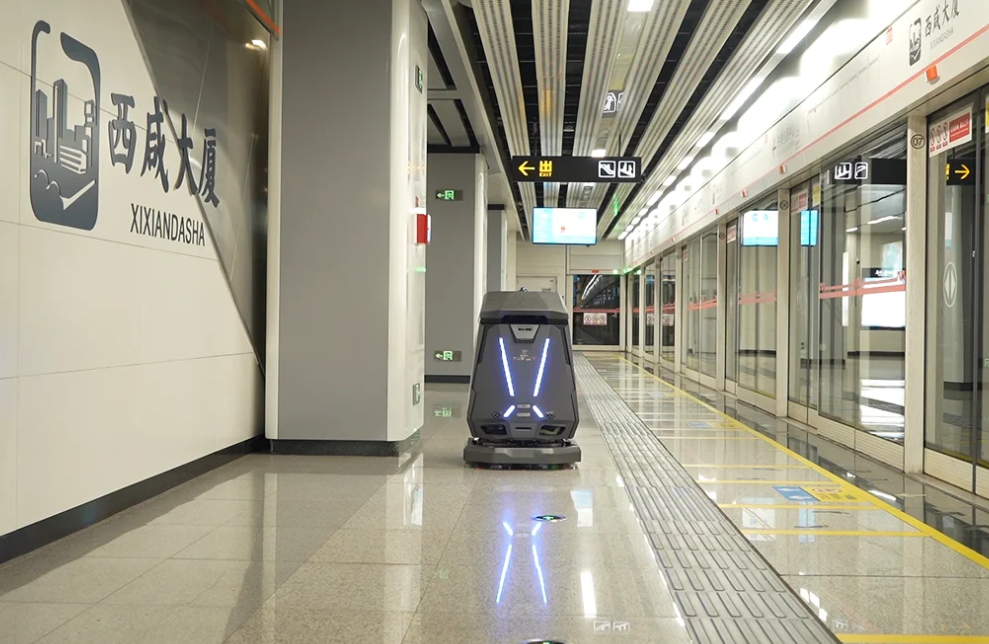
To meet that, the Skywalker 50 was deployed as a commercial floor cleaning robot running scheduled routes through station floors. It used its sensors to steer around passengers and its workstation to recharge and refill between runs, so cleaning continued through the day rather than only after hours.
The published case confirms the deployment scale and operating environment but does not provide quantified results for coverage, labor allocation, or passenger-flow impact. Public figures for this site are limited, so exact metrics should be confirmed with Rosiwit rather than assumed.
Conclusion: Choosing the Right Robot for Public-Space Cleaning
The right robot for a large public space is defined by three traits working together: crowd-safe navigation, wide and efficient coverage, and automated 24/7 operation. Cleaning power alone does not qualify a machine for an airport or a metro station.
As you compare the cleaning robots commercial buyers shortlist for public venues, weigh those three traits against your site’s size, traffic, and hours. To identify a suitable model, explore our range and confirm the required specifications, navigation conditions, deployment process, and regional service support.