
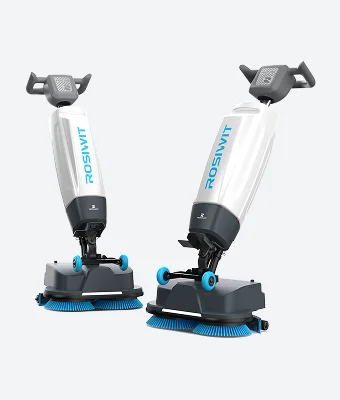
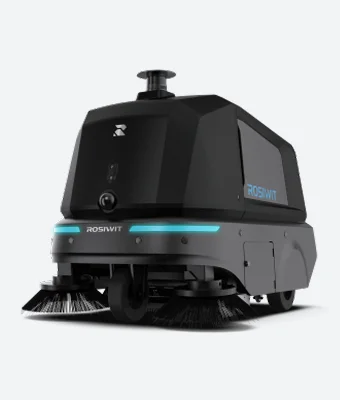

Commercial cleaning robots help facilities reduce labor shortages, improve cleaning consistency, and lower long-term operating costs by automating repetitive floor maintenance. Instead of replacing cleaning teams, they allow staff to focus on detailed tasks while robots handle large, routine cleaning schedules with documented results. At Rosiwit, we provide autonomous cleaning systems for industrial, logistics, commercial, and transportation facilities to support repeatable floor-care tasks and more efficient labor allocation.
Why Is Commercial Facility Cleaning So Hard to Staff Right Now?
Commercial cleaning is hard to staff because turnover is extreme. Commercial cleaning can be difficult to staff because high turnover, recruitment challenges, and nonstandard work schedules may disrupt service continuity. Labor is typically the largest expense in a commercial cleaning contract and can account for roughly 50% to 80% of the total bid price.
A shopping mall, airport, or warehouse may require multiple overnight cleaning shifts every day. When staff frequently leave or fail to show up, managers must either reduce cleaning frequency or pay overtime to maintain service levels.
As a result, labor shortages have become an operational challenge rather than simply a hiring issue. More commercial facilities are adopting autonomous cleaning robots to maintain consistent cleaning quality, reduce labor dependence, and improve long-term maintenance efficiency.
What Exactly Is a Cleaning Robot?

A cleaning robot is an autonomous machine that sweeps, scrubs, and vacuums floors on its own, without an operator walking behind it. That autonomy is the core difference from a traditional walk-behind scrubber, which needs a person for every hour it runs.
A robotic cleaning machine converts a repetitive task into a scheduled, self-directed one. That is why facility managers treat it as a staffing tool, not just equipment.
How does a floor cleaning robot navigate a busy facility?
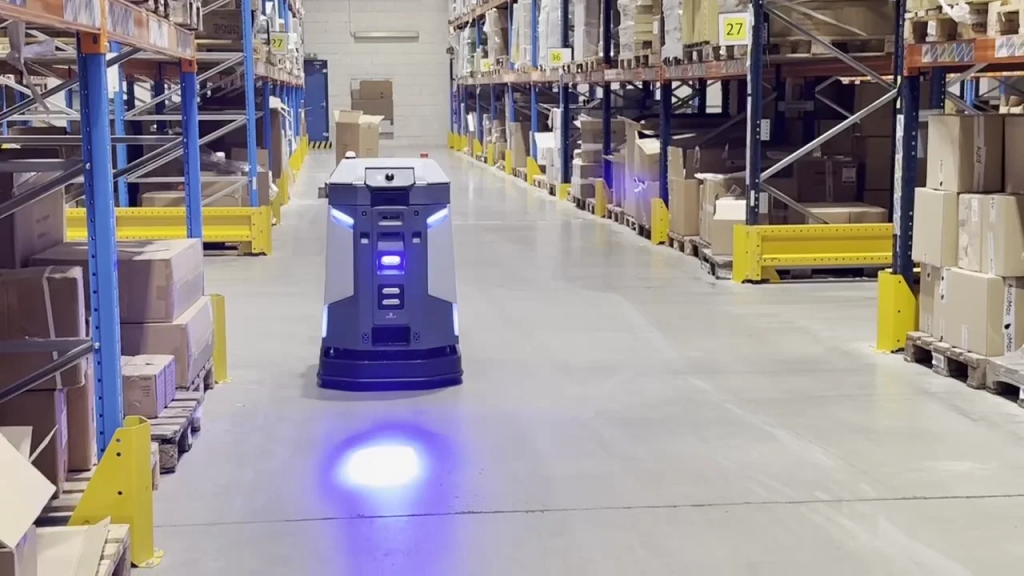
A floor cleaning robot navigates using 3D LiDAR and vision sensors that build a live map and steer around people. This is called SLAM (Simultaneous Localization and Mapping), and it lets the robot work safely in aisles full of foot traffic.
Because it maps and repeats routes precisely, the robot cleans the same area to the same standard on every pass. For example, a warehouse aisle gets identical coverage at 2 a.m. and 2 p.m., which manual crews rarely achieve.
How Do Cleaning Robots Actually Change Day-to-Day Maintenance?
Cleaning robots change daily maintenance by shifting people from pushing machines to supervising fleets. Instead of one worker per scrubber, one supervisor oversees several robots plus the detail work machines cannot reach.
The industry is moving this way fast. Adoption of cleaning robots is increasing, although published growth forecasts vary depending on the geographic region and the types of cleaning robots included.
What changes for procurement and facility managers?
For buyers, the biggest change is predictability. Robots run on a fixed schedule with digital logs, so a facility manager can prove a floor was cleaned, when, and over how much area, instead of relying on a clipboard.
However, robots do not replace people. The realistic model is hybrid: machines handle large open floors overnight, while staff handle detail work. As a result, the same headcount covers more square footage with steadier quality.
| Factor | Manual crew only | Hybrid (robot + staff) |
| Coverage of large floors | Depends on shows up | Scheduled , unattended , repeatable |
| Proof of service | Clipboard or trust | Digital logs and route data |
| Labor exposure | 1 operator per machine | 1 supervisor per several robots |
| Quality consistency | Varies by shift and worker | Same route , same standard each pass |
Which Rosiwit Robots Fit Commercial and Industrial Facilities?
Rosiwit Technology Company Limited designs each autonomous cleaning robot for commercial and industrial spaces such as factories, warehouses, malls, and transport hubs, combining 3D SLAM navigation with cloud-based fleet management. Two models show how Rosiwit matches robots to facility size and required scrubbing pressure.
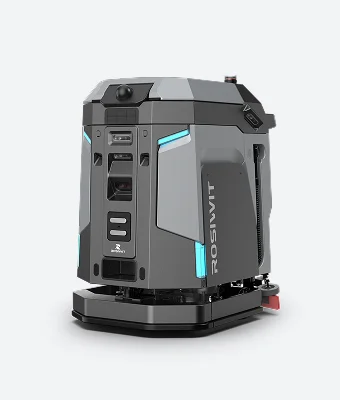
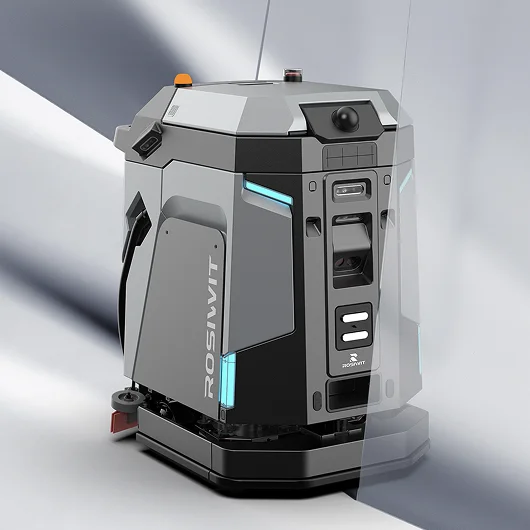
Skywalker GT: for indoor commercial spaces
The Skywalker GT is a mid-size indoor scrubber for malls, offices, and retail floors. It applies 33 kg of down pressure and runs at around 60 dB, quiet enough for spaces with people nearby.
It navigates with 3D LiDAR, RGB-D vision, and ultrasonic sensing, and docks at a 5-in-1 station. Consumables swap in about 10 seconds and core components in about 10 minutes, and it ships with a 2-year warranty.
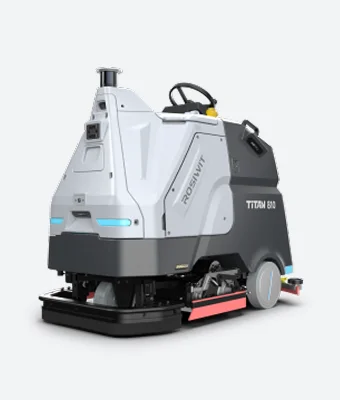
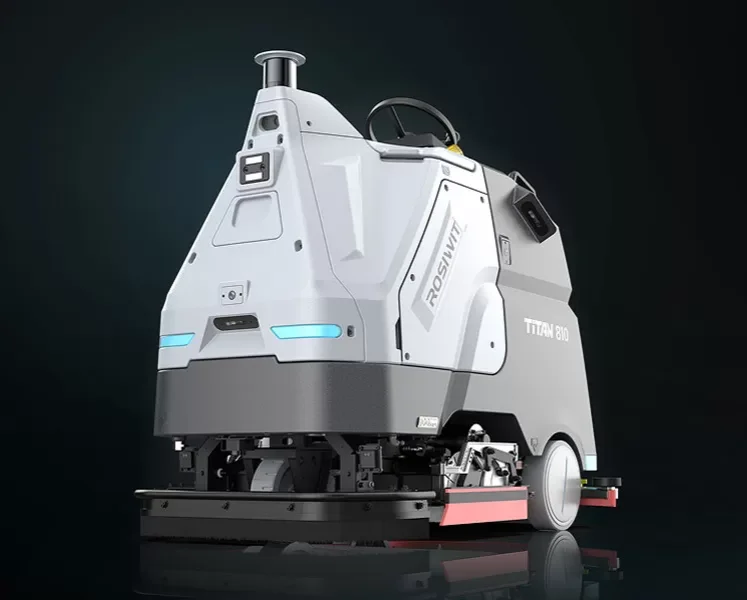
Titan 810: for large industrial floors
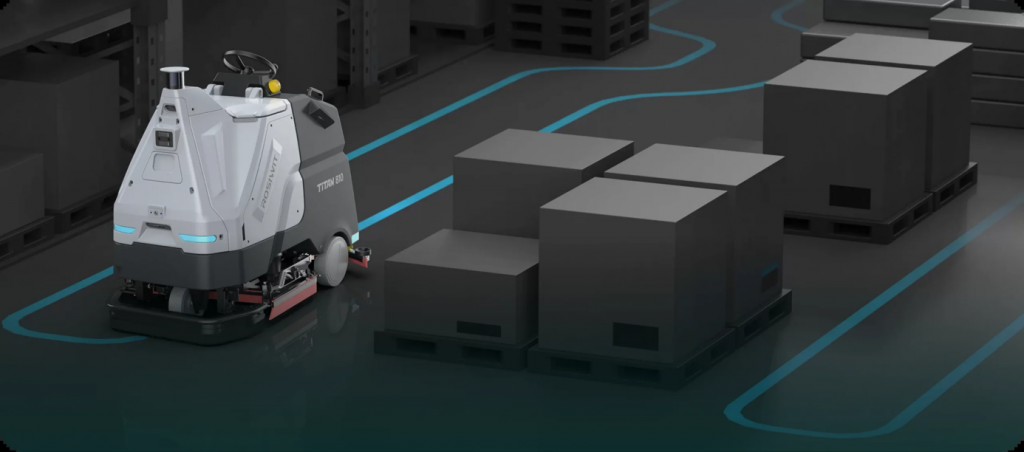
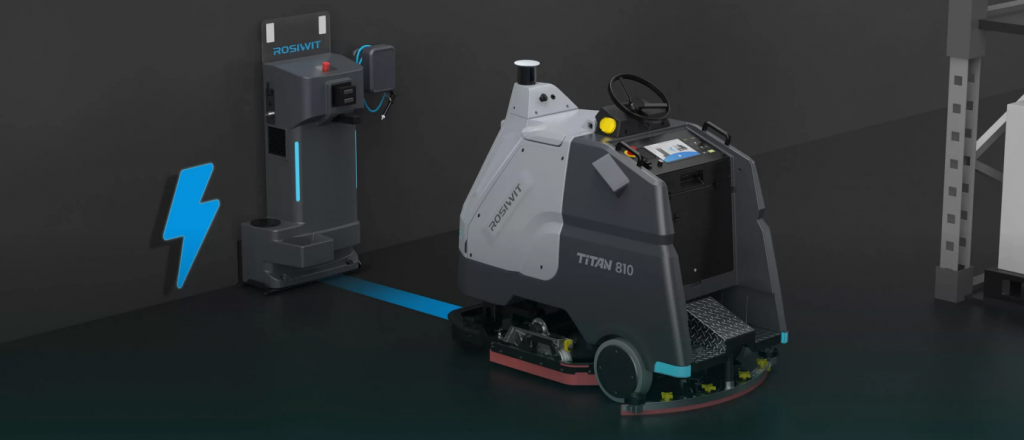
The Titan 810 is an industrial robotic cleaning machine for high-volume sites. It cleans up to 5,200 m² per hour across an 810 mm working width, runs about 6.5 hours per charge, and applies up to 115 kg of down pressure for heavy soil.
Built for scale, it carries 150 L and 190 L tanks, weighs 450 kg, and climbs grades up to 11 degrees. It uses NVIDIA Orin-powered processing and 3D LiDAR, connects to the Rosiwit 365 platform, and is listed in our published materials as having UL and CE 63327 certification.
| Spec | Skywalker GT | Titan 810 |
| Best-fit environment | Indoor commercial (malls, retail, offices) | Large industrial (factories, warehouses) |
| Cleaning efficiency | Mid-size indoor coverage | Up to 5,200 m² / hour |
| Down pressure | 33 kg | Up to 115 kg |
| Working width | Mid-size | 810 mm |
| Navigation | 3D LiDAR + RGB-D + ultrasonic | 3D LiDAR + NVIDIA AI |
| Management | 5-in-1 docking station | Rosiwit 365 cloud platform |
How Should Buyers and Dealers Evaluate a Robotic Cleaning Machine?
Buyers and dealers should evaluate a robotic cleaning machine on fit, proof, and serviceability, not spec sheets alone. The real question is whether the robot removes labor pressure in your facility, because that is where the return comes from.
Buyer vs. dealer: what should each prioritize?
End-user buyers (procurement and engineering at factories, malls, and retailers) should prioritize floor area, surface type, and traffic. Match those to coverage and down pressure first, then confirm the digital logs your contracts require.
Dealers and agents (including distributors moving from traditional equipment lines) should prioritize serviceability, warranty, and fleet software, which drive support cost and resale margin more than headline specs.
- Confirm the fit: floor size and soil level against coverage and down pressure.
- Demand the proof: cloud management and route logs for service verification.
- Check the service model: swap times, spare parts, and warranty length.
Explore the full Rosiwit robot range to compare models against your site before you commit.
Conclusion: The Shift Toward Automated Facility Maintenance
Cleaning robots are changing facility maintenance by helping facilities manage staffing pressure and automate suitable repetitive floor-care tasks. Where staffing and coverage are persistent challenges, automation may become a practical operational option.
The practical path is hybrid, not headcount-free. Robots hold the large floors to a consistent, logged standard while people handle detail work, so the same team covers more space with steadier results. The decision now is simply which robot fits which facility, and how soon to start.