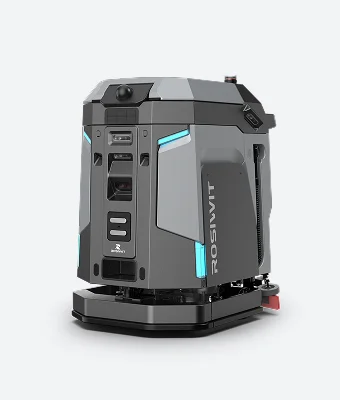

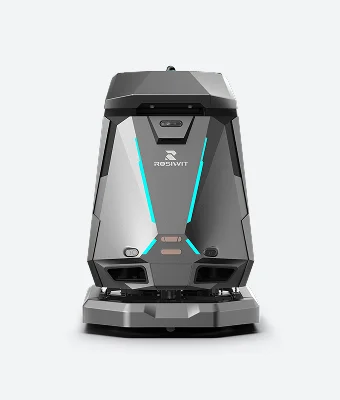

Maintaining hygiene in heavy industrial environments presents distinct challenges involving steep ramps, heavy debris, and dynamic forklift traffic. Plant engineers evaluating automated sanitation options must prioritize mechanical torque, structural stability, and workplace safety protocols over basic cosmetic scrubbing features.
Deploying a heavy-duty industrial cleaning robot allows manufacturing plants to maintain consistent floor safety without interrupting daily operational workflows. As an engineering team at Rosiwit, we focus on developing rugged hardware designed to navigate these demanding physical layouts.
Motor Power and Incline Traction Mechanics
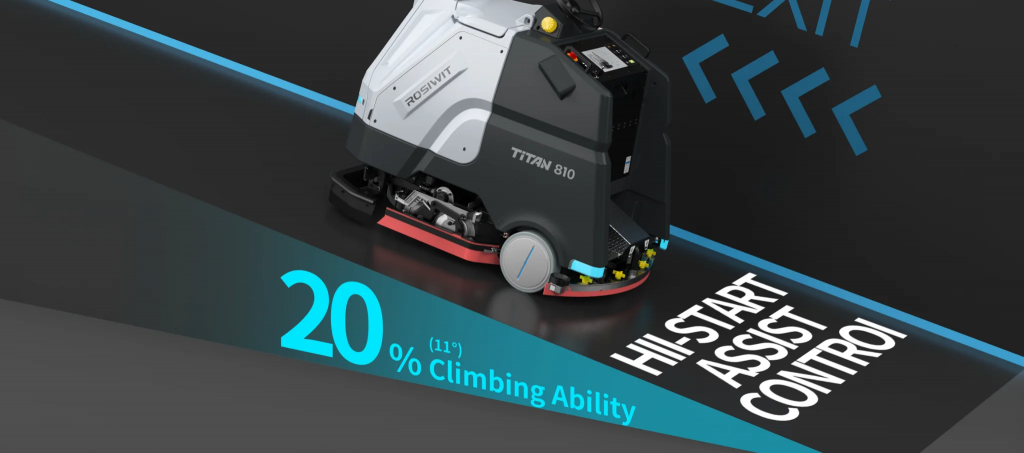
Traversing internal warehouse ramps demands substantial drive torque and reliable wheel traction. Industrial facilities often feature sloping transition zones between storage bays, requiring robust drive assemblies that prevent back-sliding under heavy payload conditions. High-power 1500W drive motors serve as a core power foundation; paired with optimized tire friction and anti-slip traction control, the cleaning unit maintains stable forward momentum on smooth resin flooring and damp concrete slopes to avoid backward slippage during climbing.
High-torque drive motors maintain continuous wheel rotation under heavy fluid weight and elevated brush down-pressure. Traction control algorithms balance power delivery across drive wheels, preventing slippage on greasy or polished floors. Selecting machinery with adequate mechanical power maintains consistent travel speeds during demanding incline transitions.
Safety Alert Integration in Dynamic Environments
Shared industrial workspaces require clear visual and acoustic warnings to alert surrounding equipment operators. Busy logistics centers present severe auditory and visual distractions, making subtle warning systems virtually ineffective. Implementing 360° surrounding sound and light safety alerts creates immediate spatial awareness, notifying forklift drivers and pedestrians when automated machinery operates nearby.
Multi-directional flashing strobes improve visibility around blind corners and high-racks. Concurrently, directional acoustic beacons adjust volume dynamic ranges based on background factory noise levels. Integrated alarm systems significantly reduce collision risks, allowing machinery to function smoothly within high-density warehouse environments.
Structural Frame Stability and Chassis Durability
Heavy industrial floor maintenance requires chassis designs that withstand accidental impacts from palleted inventory and mobile industrial equipment. Lightweight plastic frames warp under continuous heavy duty, leading to misaligned brush decks and premature mechanical failures. Reinforced steel chassis construction absorbs minor collisions while keeping internal electronic assemblies securely protected.
Heavy-duty frame housing guards drive assemblies and water tanks against physical stress during continuous multi-shift operations. Protecting internal components reduces maintenance overhead and preserves alignment across structural drive shafts. Durable chassis engineering maintains long-term reliability across demanding manufacturing facilities.
Down Pressure Dynamics for Industrial Grime
Removing stubborn oil stains, tire marks, and embedded metal filings requires high mechanical brush pressure. Standard commercial scrubbers lack the downward deck force necessary to lift heavy grease, requiring multiple cleaning passes across dirty warehouse floors. Heavy-duty deck actuators apply intense mechanical force directly to floor coatings to break up dense surface contamination.
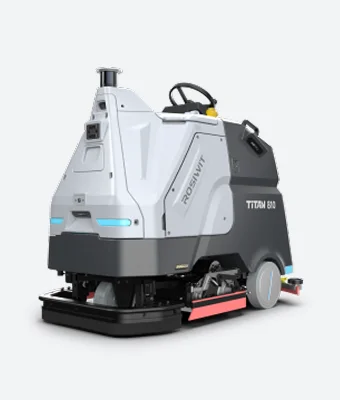
Variable down-pressure controls allow operators to adjust scrubbing intensity according to surface condition and soil concentration. The Titan 810 utilizes heavy brush force and massive torque delivery to clean stubborn industrial residue effectively in single passes. High mechanical pressure improves cleaning efficiency while minimizing chemical detergent consumption.
Fluid Recovery Ratios and Vacuum Efficiency
Incomplete fluid recovery creates dangerous standing water, increasing slip hazards for warehouse foot traffic and transport vehicles. Powerful vacuum turbines must extract heavy slurry completely, even when navigating tight turns or uneven concrete seams. High-airflow extraction systems pull wastewater immediately into recovery tanks, leaving floors dry almost instantly behind the scrub deck.
Adjustable squeegee assemblies maintain firm floor contact across expansion joints and rough surfaces. Parabolic squeegee designs channel extracted water efficiently into central suction hoses, preventing trailing water lines along outer cleaning paths. Effective fluid recovery keeps facility walkways safe and dry during active operational shifts.
Battery Chemistry and Multi-Shift Operations
Continuous factory operations demand reliable battery systems capable of supporting long operational windows without frequent mid-shift charging delays. Lithium-ion battery packs offer high energy density, fast recharging speeds, and steady voltage discharge throughout complete operational cycles. Evaluating usable battery capacity alongside drive system consumption reveals actual real-world operational coverage.
Fast opportunity charging allows autonomous machinery to replenish energy during standard shift breaks or scheduled loading pauses. The Titan 810 incorporates high-capacity battery technology, providing extended runtimes across massive industrial footprints without interrupting daily production schedules. Efficient energy management maximizes equipment availability across multi-shift facilities.
Navigation Reliability and Multi-Sensor Fusion
Navigating dynamic logistics hubs filled with moving inventory requires sophisticated spatial tracking capabilities. Utilizing an advanced industrial floor cleaning robot equipped with multi-sensor fusion arrays allows equipment to construct accurate real-time facility maps. Combining LiDAR rangefinders with ultrasonic sensors prevents navigation failures caused by dust, airborne particles, or ambient reflection.
Advanced processing hardware recalculates clean routes dynamically when temporary inventory stacks block primary pathways. Intelligent path generation eliminates repetitive coverage, saving battery energy and brush wear over broad floor areas. Reliable spatial perception maintains uninterrupted floor care schedules without constant human supervision.
Fleet Telemetry and Automated Maintenance Workflows
Modern facility management relies on continuous digital oversight to monitor asset health and maintenance productivity. Connecting an industrial cleaning robot to centralized cloud dashboards gives fleet managers real-time visibility into clean square-footage, water usage, and component wear metrics. Comprehensive telemetry transforms raw operational data into actionable maintenance schedules.
Automated self-servicing docking stations handle fluid drainage, water replenishment, and battery charging without requiring manual assistance. Integrating automated workstations transforms an industrial floor cleaning robot into a self-sustaining utility asset capable of running during overnight maintenance windows. Streamlining routine servicing reduces labor requirements and keeps factory floor care continuous.
Conclusion
Selecting heavy-duty floor care equipment requires balancing drive power, chassis durability, fluid extraction efficiency, and intelligent safety systems. Our engineering team at Rosiwit remains focused on designing robust automated machinery that optimizes floor maintenance across complex industrial landscapes.