

A gym floor, a restaurant dining room, and a hospital supply corridor do not look alike, but they share one problem: not enough room for a full-size cleaning machine, and too much foot traffic to leave a mop bucket sitting in the aisle.
Compact electric scrubbers are built to work in exactly these tight, high-traffic spots. Companies like Rosiwit design walk behind machines for narrow layouts most cleaning equipment was never sized for. This guide compares an electric floor scrubber against a mop and bucket, and shows where the smaller machine actually wins.
Why Does Cleaning Method Matter More in Small Commercial Spaces?
Small commercial spaces need a different cleaning approach than open warehouses, because narrow layouts limit which machines fit and heavy foot traffic limits when cleaning can happen at all.
What Makes Gyms, Restaurants, and Kitchens Different From Large Facilities?
Gyms, restaurants, and kitchens pack equipment, tables, and prep stations into a fraction of the floor space a warehouse has, leaving narrow paths instead of open aisles. The same problem shows up inside much larger venues too: a supermarket checkout lane, a hospital supply corridor, or a mall restroom often has less usable width than the sales floor around it, despite sitting inside a building with heavy pedestrian traffic.
Why Does Traditional Mopping Fall Short in These Spaces?
A mop and bucket struggles most exactly where space is tightest, since there’s nowhere to keep a bucket out of the way of staff or customers. Commercial cleaning research has also linked single-bucket mopping to cross-contamination, because the same water that picks up dirt in one area gets carried and redeposited in the next.
| Space Type | Narrow-Layout Challenge |
| Gym | Equipment rows, tight turns between machines |
| Restaurant / Kitchen | Table spacing, prep stations, wet-floor risk |
| Supermarket | Narrow aisles and checkout lanes |
| Hospital | Patient areas, equipment, and supply corridors |
| Mall | High-traffic corridors, retail areas, and restrooms |
What Is an Electric Floor Scrubber and How Does It Differ From a Mop and Bucket?
An electric floor scrubber applies water, agitates the floor with a brush, and vacuums up the dirty water in a single pass, instead of spreading the same water across multiple areas.
How Does a Walk Behind Floor Scrubber Clean Differently Than Mopping?
A walk behind floor scrubber separates clean and dirty water into two tanks, so the solution touching the floor stays consistent from the first pass to the last. A mop and bucket does the opposite: the same water gets reused until it’s replaced, so cleaning quality declines as the job goes on.
What Does an Electric Floor Scrubber With Brushes Actually Do?
An electric floor scrubber with brushes uses rotating brushes to physically loosen grime the way scrubbing by hand would, but at a steady speed and pressure a person can’t sustain over a full shift.
- Applies clean solution and agitates with brushes in one pass
- Recovers dirty water immediately instead of leaving it to air-dry
- Leaves the floor dry enough to walk on right behind the machine

How Does Rosiwit’s Pilot One NEO Fit Small, Narrow Spaces?
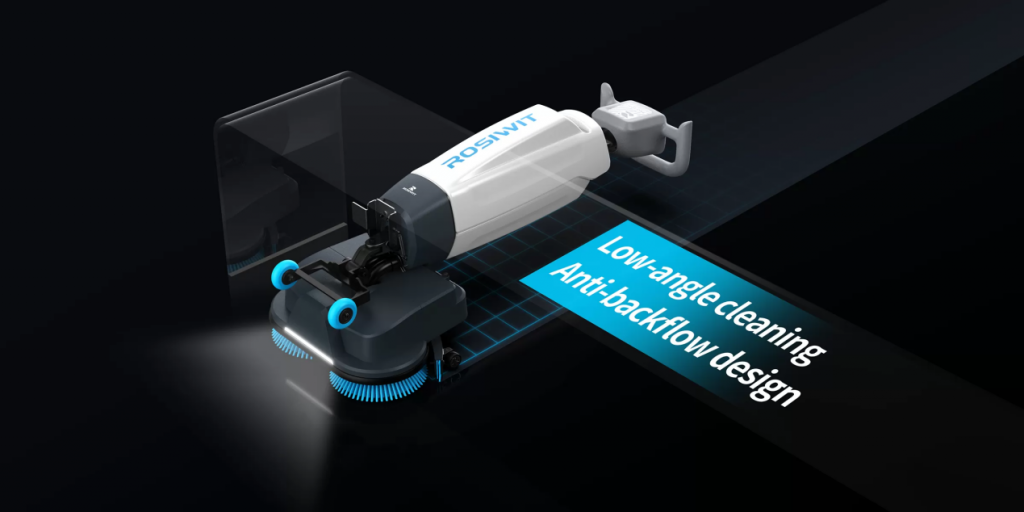
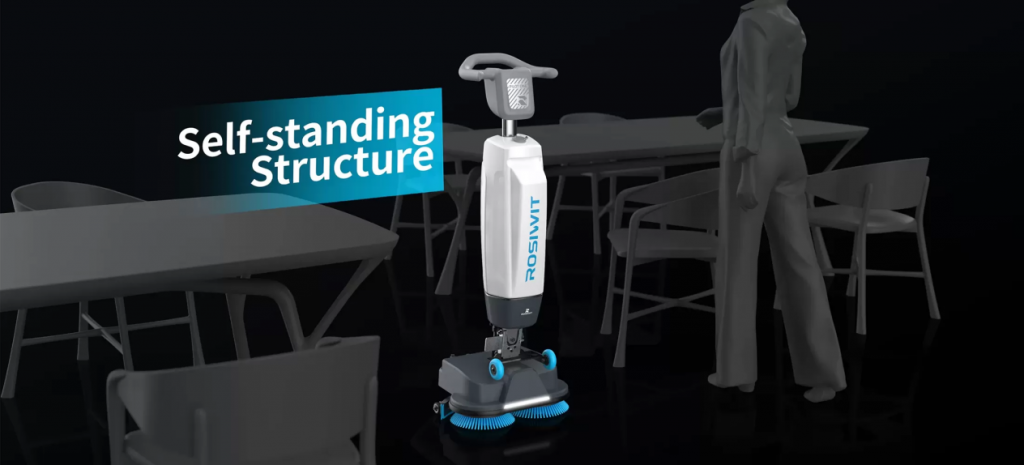
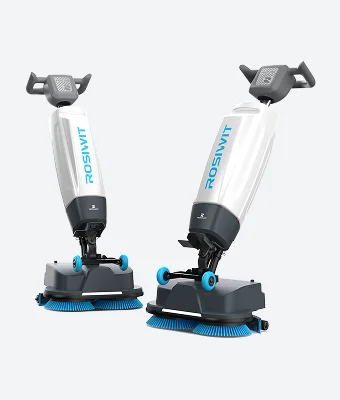
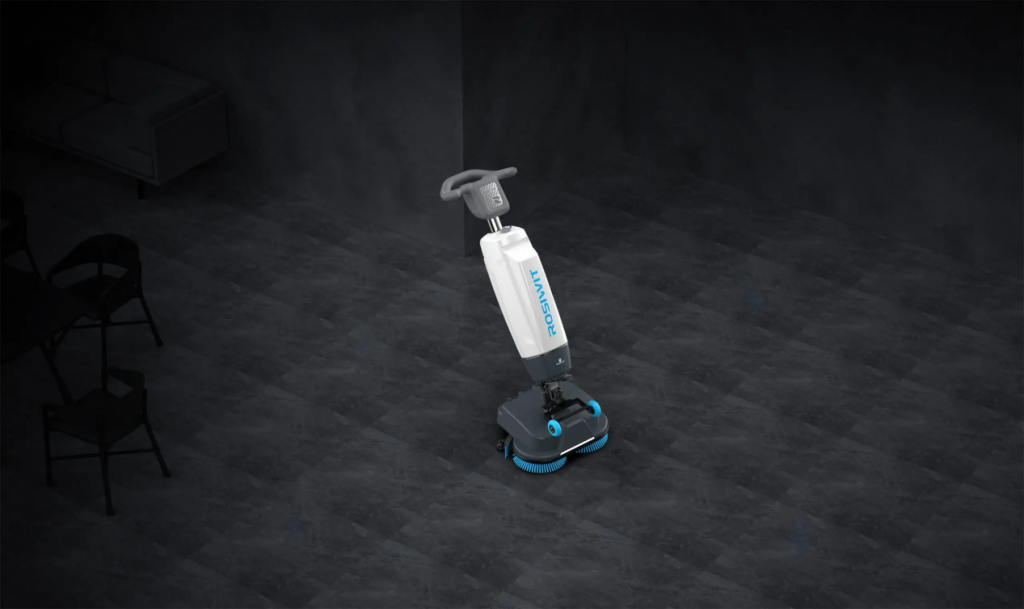
Rosiwit’s Pilot One NEO is an operator-guided electric walk behind floor scrubber for compact, high-traffic spaces. Its lightweight design, dual brushes, replaceable battery, and 360° maneuverability simplify cleaning around obstacles.
What Are the Pilot One NEO’s Core Specifications?
Pilot One NEO Feature Specification Runtime Up to 90 minutes Cleaning efficiency 1,200 m²/h Water tanks 5L + 5L Weight 18 kg Brush speed 300 RPM, dual brushes Labor savings 50%+ Compatible floors Tile, terrazzo, marble, epoxy, sealed concrete How Does the Pilot One NEO Handle Navigation in Tight Layouts?
The Pilot One NEO’s self-standing design and 360° maneuverability let it work in spaces too small for a machine that needs room to turn around. It stands upright on its own during cleaning pauses and battery swaps, and a front-mounted motor filter keeps suction consistent instead of losing power as the tank fills.

Electric Floor Scrubber vs Traditional Cleaning — Which Wins for Small Spaces?
The right choice depends on how much floor there is to cover and how often it needs cleaning, not on which method sounds more modern.
When Does a Mop Still Make Sense?
A mop still makes sense for small, occasional spot cleaning, like wiping up a single spill or reaching a corner no machine can access. Facilities cleaning only a few hundred square feet a day may not need a machine at all.
When Does an Electric Floor Scrubber With Brushes Pay Off?
An electric floor scrubber with brushes pays off once a space is cleaned daily and foot traffic doesn’t stop for cleaning to happen. That includes gym floors between classes, restaurant dining rooms between services, and the narrow, high-traffic corners of supermarkets, hospitals, and malls where a bucket would be in the way all day.
Factor Mop and Bucket Electric Floor Scrubber Water per pass Reused until changed Fresh solution each pass Drying time Slow, leaves residue Fast, single pass Best fit Occasional spot cleaning Daily cleaning in high-traffic areas What Should You Check Before Switching to a Walk Behind Floor Scrubber?
A walk behind floor scrubber is still a capital purchase, so deployment time and after-sales support deserve the same attention as the spec sheet.
How Long Does Deployment Take in a Small Facility?
Deployment in a small facility should take less time than in a large one, but it still depends on staff training, not just delivery. Ask a supplier for the actual time from delivery to a staff member running the machine unsupervised.
Why Does Overseas After-Sales Support Matter Even for Compact Equipment?
A compact scrubber still needs replacement brushes, filters, and batteries, so parts availability matters regardless of the machine’s size. Confirm parts-stock location and response-time commitments for imported equipment before signing a purchase order.
- Facility managers:confirm training time and parts availability for your region
- Distributors:confirm response-time commitments you can pass on to clients
Conclusion
For gyms, restaurants, kitchens, and the narrow corners of larger high-traffic venues, an electric floor scrubber earns its cost once a mop and bucket becomes the bottleneck, not before.
- Measure the space and daily foot traffic before comparing machines
- Weigh labor savings and drying time once fit is confirmed
- Confirm deployment time and after-sales support before signing
Facility managers and distributors can review the Pilot One NEO’s full specifications on Rosiwit‘s product page.